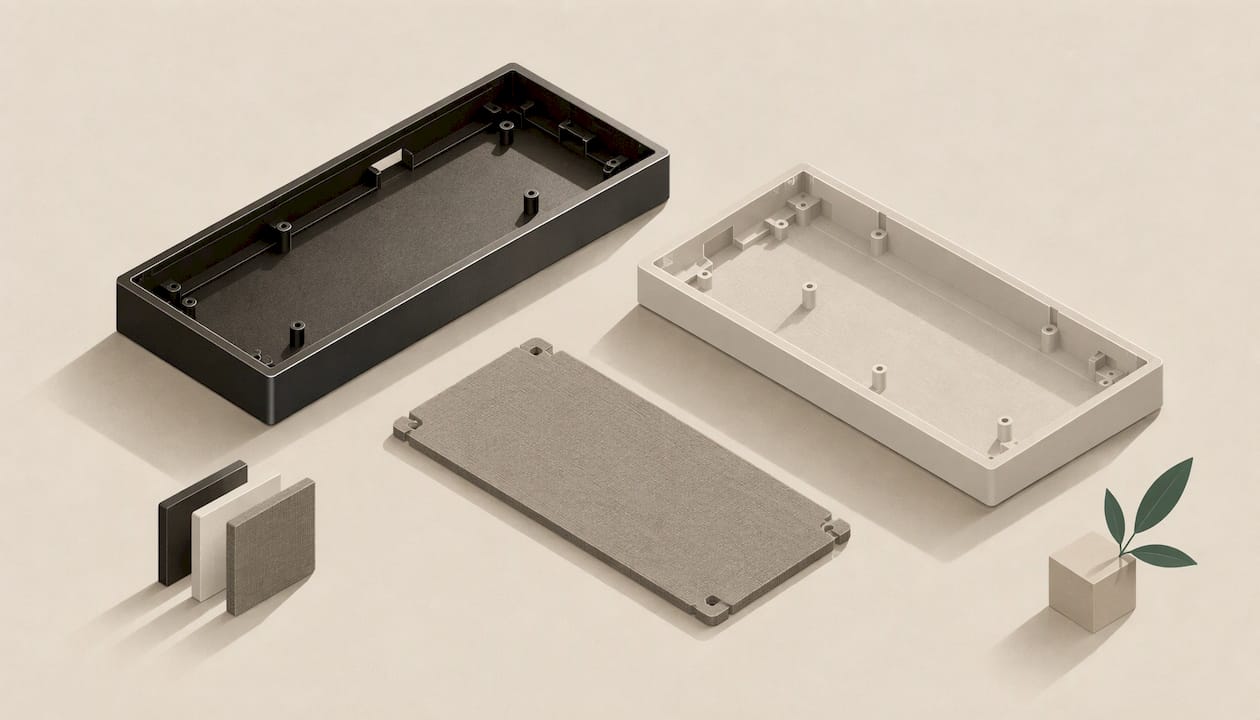
A nylon keyboard case is a light, tough polymer shell. Next to aluminum it is far less dense, and next to basic plastic it is built for longer wear. If you type all day, game, or carry your board between desks, that mix of low weight and durability is the reason to look at nylon first. On our boards the case is also screwless nylon, which means nothing in the shell has to be tightened or loosened by hand. This guide explains how nylon compares with ABS, polycarbonate and aluminum, what each material does to weight and sound, and what to check before you buy.
TL;DR
- Nylon is a polyamide plastic, and it is much lighter than aluminum: roughly 1.1 to 1.2 g/cm³ against about 2.70 g/cm³.
- Case material shapes sound and weight, but the plate, mounting, switches and foam shape sound just as much as the shell does.
- Aluminum gives a heavy, planted board with a brighter ring. Plastics, nylon included, give a lighter board and a deeper, softer tone.
- Polycarbonate is clear and good for RGB, but it reacts to heat and moisture more than metal does.
- Our KeBe keyboards use screwless nylon cases, assembled by hand in Canada.
Table of Contents
- What a nylon keyboard case actually is
- The main keyboard case materials
- Nylon vs aluminum: weight and everyday use
- Does the case material change how a keyboard sounds?
- Polycarbonate vs aluminum: where nylon fits
- The case is only one part of the board
- Which material suits which typist
- How to check a case before you buy
- Why we use screwless nylon
- A keyboard built around the nylon case
- Frequently asked questions
- Sources
What a nylon keyboard case actually is
Nylon is a polyamide, a family of plastics known for toughness and low friction. It is already common inside keyboards: nylon is often used for switch housings because it is easy to process, with a Shore D70 hardness (a measure of how hard a plastic feels under pressure) and a low sliding-friction coefficient of 0.28. That is why it suits parts that get handled and pressed all day.
When the keyboard world talks about "nylon" cases, it usually means one of two things. One is a case moulded wholly from nylon. The other is nylon-reinforced plastic, which one keyboard case guide describes as having more strength and long-term durability than basic plastic, with better acoustics than thin ABS, and as a mid-range option.
If you searched for a nylon keyboard case and found piano gig bags and soft carry covers, that is a different product: fabric bags for transporting a keyboard instrument. This article is about the shell of a computer keyboard itself, the part that holds the switches, the plate and the electronics.

The main keyboard case materials
Most cases fall into a handful of materials. Knowing them makes the nylon-versus-aluminum question much easier.
ABS
ABS is the most common case plastic because it is cheap and easy to injection-mould. According to a mechanical keyboard case guide, it also resists corrosive chemicals and physical impact. Many budget keyboards use it. The same guide notes that thin ABS can feel hollow and can yellow with age, which is a main reason people move up to tougher materials.
Polycarbonate
Polycarbonate (PC) is the transparent or frosted plastic you see on RGB boards. WIRED's shopping guide describes it as dense and rigid, with a deeper typing sound that lets RGB light shine through. It also notes that it can scratch and crack more easily than aluminum. One guide adds that it doesn't yellow like ABS.
Aluminum
Aluminum is the premium metal choice. A machining guide puts 6-series aluminum at about 2.70 g/cm³, against 1.20 for polycarbonate and 1.05 for ABS. That density is why metal boards feel planted on a desk and ring brighter when you type.
Nylon
Nylon sits in the light, tough part of the range. A custom-case design guide lists it at roughly 1.1 to 1.2 g/cm³, with good machinability and very light weight, which is about the same density as polycarbonate and a fraction of aluminum's.

Nylon vs aluminum: weight and everyday use
Weight is the clearest difference. Aluminum is more than twice as dense as nylon, so an aluminum shell of the same size is far heavier. Keyboard-guide writers describe typical machined aluminum cases at 500 to 1,500 g depending on size. Plastic cases come in well below that.
What does that mean in practice?
- If your keyboard lives on one desk, weight is a comfort feature at most. A heavy board stays put, but you will not notice a light one sliding if the feet grip.
- If you move between home, office and a bag, lower weight is a real daily benefit. One guide recommends well-built plastic for travellers and budget buyers, and aluminum for stationary users who want stability.
- If you adjust your setup often, a lighter case is easier to rotate, tilt or pull closer. That matters for ergonomic setups where you reposition the board to keep your wrists neutral.
For typists who care about comfort, the shell's job is to stay out of the way: light enough to position, tough enough to last, and finished so the edges don't dig into your palms. Our case is built around that idea. If you want the wider picture of how keyboard design affects comfort, our guide to ergonomic mechanical keyboard benefits goes through what helps.
Does the case material change how a keyboard sounds?
Yes, but less than most buyers expect, and not in isolation.
A keyboard sound guide says construction affects sound more than the switch choice. Aluminum resonates and amplifies, plastic dampens, and the case volume, plate material, mounting method and foam all shape the result. Another guide says harder case materials accentuate the high-pitched ping and clack, and that mounting style matters more than the case material alone.
The general pattern from KEEBS101 is that plastic cases tend toward a deeper "thock" while metal cases suit a higher-pitched "clack". That fits what MechKeyFoundry's density figures suggest: aluminum's roughly threefold density over polycarbonate is the core reason the two materials sound like different instruments.
| Material | Typical weight | Typical sound | Best for |
|---|---|---|---|
| Nylon | Very light | Deeper, softer tone | Daily typing, carrying, comfort |
| ABS | Light | Warm, can sound hollow when thin | Budget boards |
| Polycarbonate | Light to medium | Muted, deep | RGB, translucent builds |
| Aluminum | Heavy | Brighter, longer ring | Fixed desk setups |
The weight and density column rests on the figures above. The sound column is the general tendency the guides describe, and it varies with the board.
If noise matters at your desk or in a shared office, the shell is only part of the answer. Switch type and height play a large role, and we cover that in what makes low-profile keyboards loud or quiet.
Polycarbonate vs aluminum: where nylon fits
People comparing materials often reach nylon through the polycarbonate-versus-aluminum debate, so here is how the three line up.
Polycarbonate is about half as dense as aluminum, which gives a lighter case and, according to KeyboardCNC, a generally deeper, quieter, less resonant tone. Aluminum rings brighter and holds the tone longer. The same source notes that polycarbonate expands more with heat and absorbs a little moisture over time, so makers have to design for it carefully.
Nylon lands close to polycarbonate on weight, with the added advantage of being a tough, low-friction engineering plastic already trusted in switch housings. You get the lightness of a plastic case without relying on the clear-shell look that polycarbonate is chosen for. If transparent RGB glow is your priority, polycarbonate is the material designed for that. If lasting, light, everyday comfort is the priority, nylon is built for it.
Price tiers
Material also affects cost, and the guides agree on the order. ABS is the cheapest, polycarbonate sits in the middle, and machined aluminum is the most expensive tier. WIRED notes that polycarbonate often costs about the same as aluminum because both are CNC-machined from solid blocks rather than injection-moulded. A moulded nylon shell avoids that machining cost, which is part of why nylon is a mid-range material.
The case is only one part of the board
A material debate can distract from what you actually touch. WikiKeyboard points out that many high-end boards pair a plastic exterior with a metal plate, keeping weight down while the plate gives rigidity, and that switches and keycaps do much of the work in how a board sounds and feels. KEEBS101 makes a similar point: premium plastic can sound excellent, while a cheap metal case can sound unpleasant.
So judge the whole keyboard:
- Layout and key spacing. These decide how far your fingers travel. Our Matrix-Dvorak layout uses a straight-column grid and hand-centered letter placement to cut finger movement.
- Switches. Linear or tactile, low-profile or full height. Our guide to linear vs tactile switches helps you pick.
- Case rigidity and finish. Press on the corners and check the edges. A good case doesn't flex or leave sharp seams.
- Connectivity. Integrated USB-C ports and a hub save you from dongles on a small desk.
- Serviceability. Hot-swappable switches mean you can change them without soldering.
If you are still deciding between switch families, our comparison of mechanical vs membrane keyboards covers the basics.
The same trade-offs between weight, grip and protection come up in other products too, as in this phone case material guide, and the lesson carries over: the best material is the one that fits how you actually use the thing.
Which material suits which typist
Ergonomic typists. You reposition the board, use it for hours and care about wrist posture. A light, tough shell with a low profile suits you. Weight is not a feature when you are nudging a keyboard to a better angle.
Gamers. You want quick response and a board that survives heavy use. Light plastics and nylon keep the board easy to move for LAN nights or desk changes, and fast switches matter more than the shell. If you are weighing switch technologies, see our comparison of optical vs mechanical keyboards.
Professionals. You may type in an open office. A deeper, softer sound from a plastic shell is easier on coworkers than a bright metal ring, and a lighter board is simple to carry between desks.
Customizers. If you swap keycaps, switches and lighting, the case is the canvas. Per-key RGB, hot-swap sockets and an easy-to-open shell make tinkering simple. A screwless case removes one common obstacle: there are no tiny screws to lose or over-tighten.
How to check a case before you buy
Whatever the material, a short inspection tells you more than the spec sheet does.
- Flex. Press the middle and corners while holding the board. It should feel solid.
- Edge finish. Run a finger along the seams and the palm-rest area. They should be smooth.
- Rattle. Tap the case and listen for a hollow or pinging sound. Thickness and design quality vary significantly in plastic cases, and internal foam improves them.
- Feet and grip. A light board needs feet that hold it in place on your desk.
- Ports. Check that the USB-C ports are easy to reach and sit flush.
Why we use screwless nylon
Most keyboard talk is about switches, and fair enough. But a keyboard is something you live with for years, and the shell is the part your hands and desk meet every day. We chose nylon because it gives us a case that is light, tough and pleasant to handle, and because it lets us build the shell without exposed screws.
Our design goal with the Matrix-Dvorak layout is simple: less finger movement, less fatigue. A light case supports that. You can angle it, slide it and set it where your wrists are comfortable, without hauling a slab of metal around. The straight-column grid and the dual-spacebar design do the work on your fingers, and the case keeps the board easy to live with.
Each KeBe keyboard is assembled by hand in Canada, with low-profile switches, hot-swappable keys, per-key RGB lighting and an integrated USB-C hub. The nylon shell is part of one thought-through board, not a standalone feature. That is how we would pick one for ourselves: start with how you type, then look at the shell that fits it.
Joshua
A keyboard built around the nylon case
If you want the shell, the layout and the switches designed together, our store lists the KeBe v2, a mechanical board, and the slim KeBe Lite. Both use the Matrix-Dvorak layout, hot-swappable keys and per-key RGB lighting, along with autocorrect, a typing trainer and our dual-spacebar design.

Browse the current models, pre-order options and waitlist on the KeBe store.
Frequently asked questions
Is nylon better than aluminum for a keyboard case?
It depends on what you want. Nylon is much lighter, at roughly 1.1 to 1.2 g/cm³ against about 2.70 for aluminum, so it suits typists who move or reposition their board. Aluminum gives a heavier, brighter-sounding board that stays planted on a desk.
Is a plastic keyboard case worse than a metal one?
Not automatically. Guides on keyboard construction note that premium plastic can sound excellent, and that internals such as the plate, mounting and foam shape the result as much as the shell. Tough plastics like nylon are built for long daily use.
Does the case material change how a keyboard sounds?
Yes, though it works with other parts. Aluminum tends to resonate and ring brighter, while plastic tends to dampen and sound deeper. Mounting style, plate material, switches and foam all affect the final sound.
What is the best material for a keyboard case?
Pick by priority. Choose a light, tough material like nylon for comfort and portability, polycarbonate for clear RGB builds, and aluminum if you want a heavy desk-bound board. Check rigidity, edge finish and internal dampening whichever you choose.
Sources
- Digitec: Keycap Kevin on plastics and switch housings
- MKB Guide: Keyboard cases guide
- Switch and Click: Guide to mechanical keyboard cases
- WIRED: How to shop for a mechanical keyboard
- MechKeyFoundry: Keyboard case material guide
- JLC CNC: How to design and make a custom keyboard case
- WikiKeyboard: Keyboard case materials
- MKB Guide: Switch sound test guide
- Cultists Network: Keyboard 101, case, plate and mounting
- KEEBS101: The case, the stand and the typing angle
- KeyboardCNC: Aluminium vs polycarbonate keyboard case