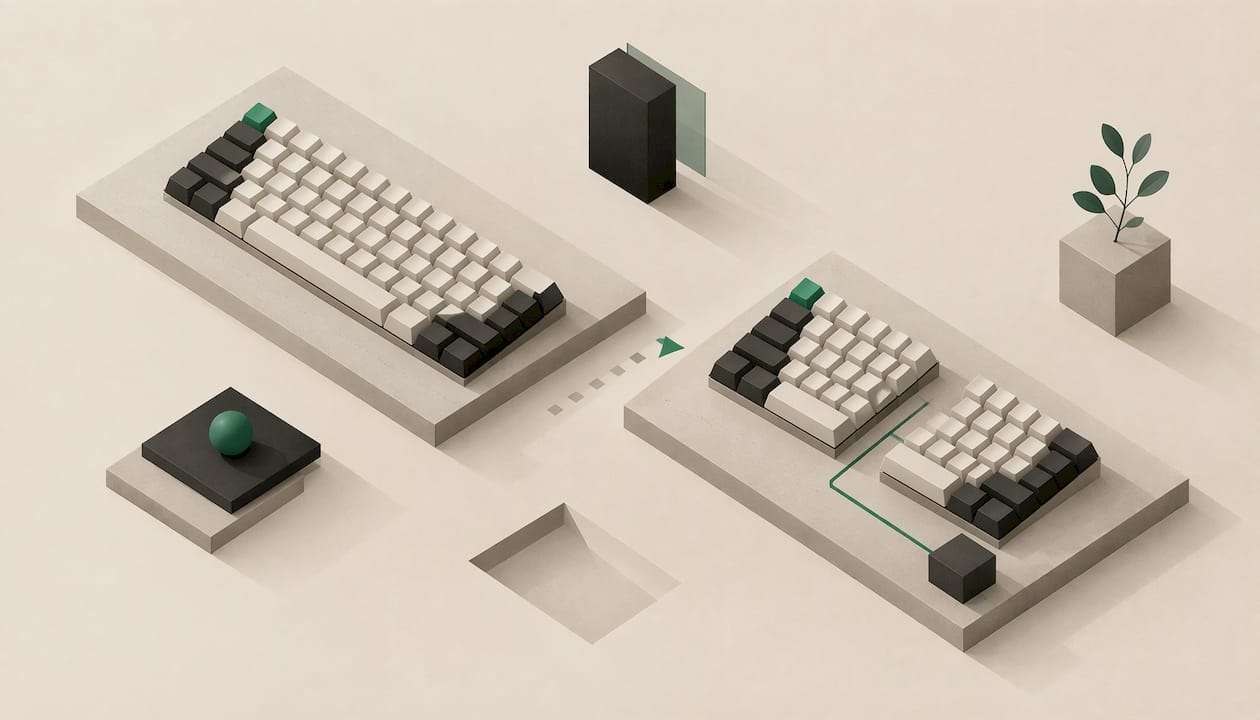
The 2026 mechanical keyboard class splits into three directions: faster gaming boards built around 8,000 Hz polling and adjustable actuation, ergonomic boards that move the keys into columns and split the halves, and modular boards you can rebuild yourself. If you type all day, the ergonomic direction is the one that changes how your hands feel by Friday afternoon. That is the direction KeBe builds in, with a Matrix-Dvorak layout that keeps your fingers close to home position. Below is what has been confirmed this year, what each launch is good for, and how to tell a real release from a rumour.
TL;DR
- The confirmed 2026 launches cover full-size gaming boards, a wired budget gaming model, a Kickstarter-funded hybrid, a modular 68-key board and a split ergonomic board with a built-in trackball.
- Most announcements quote US prices. Canadian prices, duties and shipping are settled only at checkout, so compare the final total, not the headline figure.
- The biggest real change for typists is the columnar, split design, not another speed spec.
- Hot-swap sockets and swappable plates are now the sign of a board you can keep for years.
- KeBe's Matrix-Dvorak keyboards are assembled by hand in Canada and can be pre-ordered through the store.
Table of Contents
- How to tell a confirmed release from a rumour
- The 2026 launches so far
- For gamers: faster polling, adjustable actuation
- For people who type all day: columns, splits and thumb clusters
- For enthusiasts: sockets, plates and low-profile options
- Canadian prices and availability
- Our view: why the layout matters more than the spec sheet
- Get a KeBe keyboard before the next wave
- How to pick from this year's crop
- FAQ
- Sources
How to tell a confirmed release from a rumour
A keyboard is "upcoming" in a useful sense only when the maker has announced it, shown specs and given a price or a shipping window. Anything less is a leak or a wish list.
When you read a "best of 2026" list, check three things:
- The announcement date. Several top-ranking roundups are updated for 2026 but mostly list boards that launched in earlier years. A board that was reviewed in 2024 is not new, however recently the page was refreshed.
- A price and a ship date from the maker. A launch with a stated price, such as the ones in the table below, is confirmed. A "coming soon" teaser is not.
- The region. Some launches are regional first. The modular 68-key board covered below launched in China on 11 November 2026, and a Canadian release has not been part of that announcement.
Crowdfunded boards need one more check: the campaign price is an early-bird price, and the shipping window is a schedule, not a delivery.
The 2026 launches so far
The table lists boards with a source for the date and price. Prices are in US dollars as the makers published them, because that is how they were announced. They are not Canadian prices.
| Type of board | Announced or launched | Published price | What stands out |
|---|---|---|---|
| Full-size gaming board with a built-in control deck and IPS screen | Announced at CES 2026, launched 29 January 2026 | US$349.99 | Stream Deck-style controls built into the board |
| Wireless gaming board with magnetic (TMR) sensing | Announced at CES 2026, launched 29 January 2026 | US$249.99 MSRP | New sensing technology in a gaming keyboard |
| Wired budget gaming board | Announced 16 June 2026, launched 30 June 2026 | US$119.99 | Entry price for a mechanical gaming board |
| Full-size gaming board | Revealed 26 August 2026, launched 25 October 2026 | See maker's page | Full-size mechanical layout |
| Hybrid board on Kickstarter | Announced August 2026 | US$149 early-bird | Shipping scheduled from November 2026 |
| Modular 68 or 75% board | Launched in China 11 November 2026 | See regional listing | 8,000 Hz wired polling, swappable LED screen |
| Split ergonomic board with trackball | Reported 6 November 2026 | Not yet confirmed in sources | 49 keys, columnar stagger, built-in trackball |
The sources behind those rows: the integrated Stream Deck board launched on 29 January 2026 for US$349.99; the wireless TMR board with a US$249.99 MSRP; the wired budget board announced on 16 June 2026 at US$119.99; the full-size board revealed on 26 August and launched on 25 October 2026; and the Kickstarter hybrid with a US$149 early-bird price.
Three patterns run through the list. Gaming boards are chasing latency and customizable actuation. Premium boards are adding screens and controls. And the most interesting board for people who type for a living is the one that rethinks the key grid itself.

For gamers: faster polling, adjustable actuation
If you want rapid response, the 2026 specs to look for are polling rate and actuation control.
Polling rate is how often the keyboard reports its state to the computer. The modular board that launched in China on 11 November 2026 offers wired 8,000 Hz polling, adjustable actuation, Rapid Trigger and modular 75% or 68-key layouts. Adjustable actuation lets you set how far a key travels before it registers. Rapid Trigger resets the key the moment you start releasing it, which helps in games where you tap and counter-strafe quickly.
The same technology that fits a gaming board also shows up in magnetic sensing, as in the wireless board launched in January. Both approaches shorten the time between your finger and the action on screen.
For most players, though, the gap between a good 1,000 Hz board and an 8,000 Hz board is smaller than the gap between a board that fits your hands and one that tires them out. Switch type matters here, and our guide to optical vs mechanical keyboards explains how each registers a press. If you play wired, our comparison of wired vs wireless keyboards covers the trade-offs in latency and convenience.
For people who type all day: columns, splits and thumb clusters
The most notable ergonomic launch of the year is a 49-key split board with a moderate columnar stagger, a built-in 19 mm trackball under the right thumb, two touch-sensitive scroll pads and fold-out tenting feet. TechPowerUp reported it on 6 November 2026, along with support for ZMK firmware, 2.4 GHz, Bluetooth and wired USB-C, and a plate swap that takes either low-profile or full-height MX switches.
What that tells you is where the market is going. A traditional keyboard staggers its rows because of typewriter mechanics from over a century ago, and your fingers move diagonally to reach the keys. Columnar layouts line the keys up the way your fingers actually travel. Splitting the halves lets your shoulders open up.
If you are deciding between a split board and a regular one, our guide to split keyboards vs standard walks through the adjustment period. For a wider view of what helps and what doesn't, see ergonomic keyboard vs regular and our notes on ergonomic mechanical keyboard benefits.
A layout is only half the picture. The other half is the arrangement of letters on the keys. If you are curious about learning something other than QWERTY, alternative keyboard layouts compares the main options.

For enthusiasts: sockets, plates and low-profile options
Customization has become a baseline expectation. The 2026 boards above lean on three ideas:
- Swappable switches. A hot-swap board lets you pull a switch out and push another in without soldering. Our explainer on hot-swappable keyboards covers what to check before you buy.
- Swappable plates. The split board above takes either switch height by swapping the plate, so you are not locked into one profile.
- Modular layouts. The 68-key board can be configured as a 75% or 68-key layout, which suits a desk that changes.
Low-profile switches have the shortest travel and keep your wrists flatter. If you are weighing them against full-height switches, low-profile switches explains the differences in feel, sound and who benefits.
Boards with built-in controls and screens also raise a practical desk question: where the cables go. A 6-in-1 USB-C docking station with a monitor riser can tidy the ports and lift the screen to eye level, so the keyboard setup is only one part of a comfortable desk.
Canadian prices and availability
Nearly every announcement above is priced in US dollars. For Canadian buyers that means three things.
- The final Canadian price depends on the exchange rate on the day you buy, which moves constantly.
- Duties, taxes and shipping can be added, depending on whether the board ships from a Canadian warehouse or from abroad.
- A crowdfunded or regional launch may not ship to Canada on the date the maker gives.
So compare the total at checkout, not the headline figure, and check the maker's own page for the Canadian schedule. A board assembled in Canada, like KeBe's, avoids the cross-border step.
Our view: why the layout matters more than the spec sheet
We build keyboards because we think the biggest gain in typing comfort comes from where the keys sit, not from a higher number on a spec sheet.
A standard keyboard keeps its rows staggered, so your fingers reach sideways and up for a lot of letters. Our Matrix-Dvorak layout puts the keys in straight columns and places the most-used letters under the home row, so your hands stay centred and your fingers travel less. That is the point of the design: less finger movement, less fatigue.
The same thinking runs through the rest of the keyboard. The KeBe v2 is a mechanical board with low-profile switches, hot-swappable keys and per-key RGB lighting. The KeBe Lite is the slim version. A dual-spacebar design puts a space key under each thumb, and automatic typo correction cleans up the slips that come with learning a new layout. There is a built-in typing trainer for that learning, and USB-C ports with an integrated hub, so the keyboard is also the place you plug things in.
Gamers get quick, low-travel keys. Professionals get a layout built for efficiency. Enthusiasts get hot-swap sockets and a screwless nylon case. Every board is assembled by hand in Canada.
Joshua
Get a KeBe keyboard before the next wave
If the direction you care about is comfort and efficient typing, the KeBe line is built for it: mechanical and membrane keyboards with the Matrix-Dvorak layout, low-profile switches, hot-swappable keys, per-key RGB, a typing trainer and a dual-spacebar design, assembled by hand in Canada. Upcoming models go through pre-orders and a waitlist, which puts you in line ahead of the general release.

See the current models and pre-order options in the KeBe store.
How to pick from this year's crop
Use your own work as the filter rather than the spec sheet.
- You type for hours. Prioritize layout and posture: columnar keys, a split or centred design, and low-profile switches. Our comparison of mechanical vs membrane keyboards helps with the feel question.
- You play competitively. Look for adjustable actuation, a wired connection and a high polling rate, then check the board fits your hand size.
- You like to tinker. Hot-swap sockets, plate options and open firmware matter more than a built-in screen.
- You have limited desk space. Compare tenkeyless vs full-size before you commit to a numpad.
- You buy in Canada. Compare the all-in total and the shipping origin.
Allow time to adapt to any new layout. Expect your speed to dip for the first days or weeks on a columnar or alternative layout, and use a typing trainer to rebuild it. If you have persistent hand, wrist or forearm pain, see a physician or physiotherapist rather than relying on a keyboard change alone.
FAQ
Which mechanical keyboards are confirmed for 2026?
Confirmed 2026 launches include a full-size gaming board with built-in controls and a screen, a wireless magnetic-sensing board, a wired budget gaming board, a full-size board launched in October, a crowdfunded hybrid, a modular 68-key board and a split ergonomic board with a trackball. The table above lists each with its date and published US price.
Are there new ergonomic mechanical keyboards this year?
Yes. A 49-key split columnar board with a built-in trackball was reported in November 2026. KeBe also builds ergonomic mechanical keyboards on the Matrix-Dvorak layout, with straight columns and hand-centred letter placement.
Will these keyboards be priced the same in Canada?
No. Makers quote US dollars, and Canadian totals depend on the exchange rate, duties and shipping. Compare the final price at checkout and confirm that the board ships to Canada.
Is a higher polling rate worth it?
It matters most for fast competitive games and wired setups. For daily typing, comfort, layout and switch feel make more difference than a polling figure.
Sources
- Corsair Galleon 100 SD launch, The Verge
- TMR keyboard at CES 2026, Windows Central
- Logitech G316 X announcement, CGMagazine
- Vulcan II XP reveal, APH Networks
- Keychron V6 Ultra Hybrid on Kickstarter, Green Keys
- Dareu Ultra68 launch, Gizmochina
- Orca Echo ergonomic keyboard, TechPowerUp